Rhythm organises musical events in time. A drum pattern, bassline, strummed chord or sampled phrase can be understood through the relationship between a steady pulse and the notes placed around it.
Pulse, rhythm and tempo
The pulse is an underlying regular beat. Rhythm is the pattern of note attacks, sustained notes and silences heard against it. Tempo describes the speed of the beat, often in beats per minute (BPM). At 120 quarter-note beats per minute, each beat lasts half a second. A repeating pulse does not require a sound on every beat.
Beats, bars and metre
A bar groups note values in a recurring pattern. In 4/4, a bar has the duration of four quarter notes, commonly counted 1–2–3–4. In 3/4, the typical grouping has three quarter-note beats. In 6/8, there are six eighth-note durations, commonly felt as two larger dotted-quarter beats divided into three.
The upper number in a time signature tells you how many lower-number note values fit in a bar; the lower number identifies the written value. It does not dictate instrumentation, tempo or the location of every accent.
Quarter notes, eighths and sixteenths

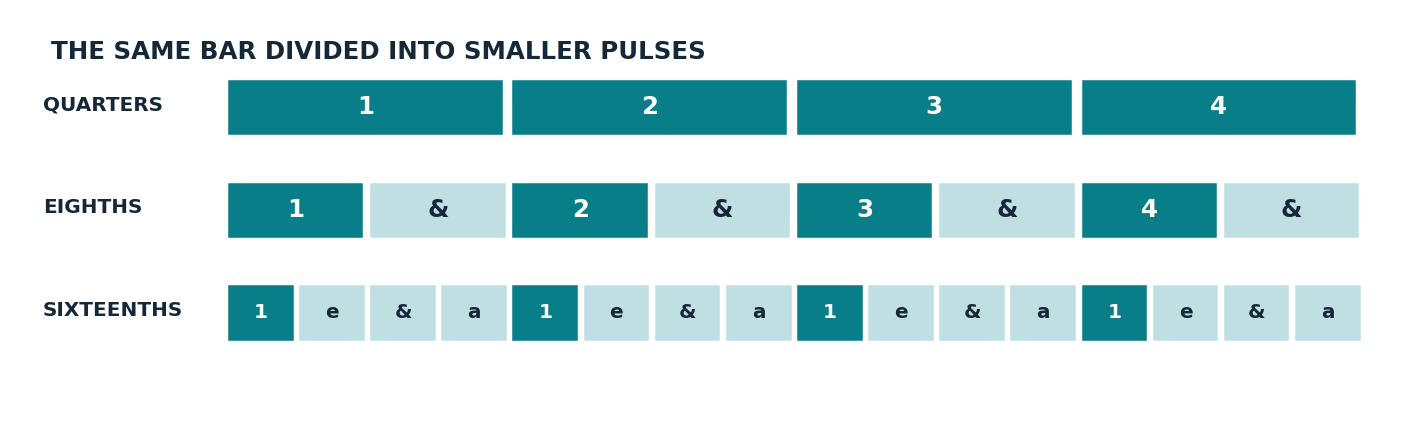
A quarter-note beat can divide into two equal eighth notes or four equal sixteenth notes. In straight 4/4, count quarter notes as 1 2 3 4, eighths as 1 & 2 & 3 & 4 &, and sixteenths as 1 e & a 2 e & a 3 e & a 4 e & a. Four quarters, eight eighths and sixteen sixteenths all occupy one 4/4 bar when performed consecutively.
A rest is a measured silence. Note duration and note onset are separate: a sustained synthesiser chord and a brief hi-hat hit can start together, but occupy time differently. A drum-sequencer step usually marks the start of a hit rather than the full duration of the sound.
Backbeats, offbeats and syncopation

A snare or clap on beats 2 and 4 creates the familiar backbeat of much pop, rock and dance music. An offbeat often means a subdivision between numbered beats. Syncopation occurs when accents or attacks shift the emphasis away from expected strong beats or anticipate them. Not every offbeat hit is necessarily strongly syncopated; its effect depends on the surrounding pattern.
Imagine kick hits on beats 1 and 3 and a snare on 2 and 4. Move an additional bass or kick attack onto the ‘&’ after beat 2. The tempo and metre remain unchanged, but the rhythmic feel changes.
Straight timing, swing and groove

Straight eighth notes divide the beat equally. Swung eighths are uneven, with a typically longer first subdivision and shorter second subdivision. The precise ratio varies by style and tempo. Triplets divide the beat into three equal parts; a long–short swing may resemble the first and third triplet positions, but swing is not fixed at one ratio.
A groove emerges from the interaction of rhythmic patterns, accents, note lengths, rests, dynamics and timing. Two patterns on the same nominal grid can feel different when their articulation or velocity changes.
Seeing rhythm in Logic Pro or another DAW
The Piano Roll displays musical events along a horizontal time axis. With a 1/16 grid in 4/4, a bar offers sixteen equally spaced possible onset positions. It does not require sixteen hits. One straightforward pattern uses kick on beats 1 and 3, snare on 2 and 4, and eighth-note hi-hats. Duplicating it and altering one hit is a useful way to hear syncopation without also changing tempo or instrumentation.
Why the distinction matters
Pulse and metre establish a framework. Rhythm is what happens inside it. Subdivision, syncopation, swing and silence provide a vocabulary for describing how music moves, whether it is played by drummers and guitarists or assembled from MIDI and samples.
Related reference: What Are Notes? · Music Production Reference Library.