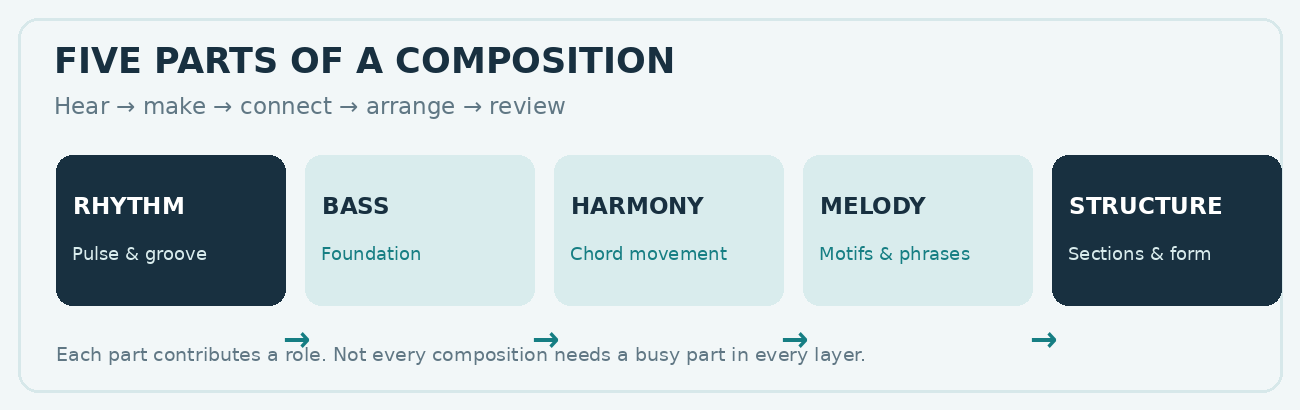
Composition joins musical elements into a purposeful whole. Rhythm organises events in time, bass supports harmony and groove, chords establish relationships, melody gives material a recognisable shape, and structure determines how it develops. A complex track is not necessarily a stronger one.
Begin with a musical intention
A composition can begin with a rhythmic cell, a chord movement, a repeated bass figure, a sample or a short melody. Choose what you want listeners to notice, then let the surrounding parts support that idea. Ambient, beat-led, acoustic and experimental approaches may organise musical time in very different ways.
Make the elements connect

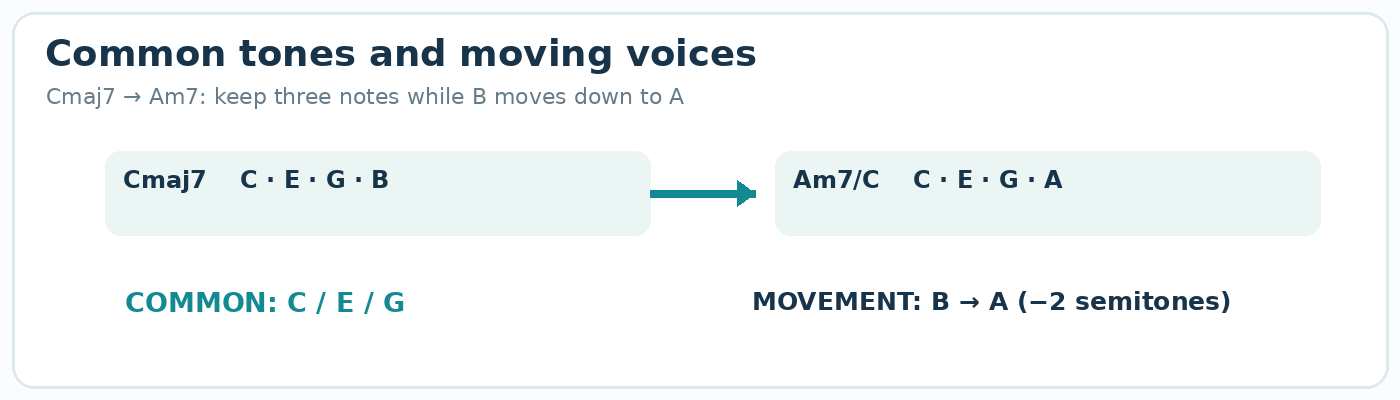
Over C–Am–F–G, bass roots C–A–F–G establish a harmonic foundation. A melody using notes related to each chord can retain a separate rhythmic contour. Drums add pulse and groove. The parts do not all need identical attacks or strictly diatonic notes, but their relationships should be understood and chosen.
A small sketch before an arrangement

A four-bar phrase can reveal whether a riff is memorable, whether the harmonic movement is clear and whether its parts compete. Variation may involve changing one note, a bass rhythm or an accompaniment register. A short sketch is often easier to evaluate than an overfilled multitrack project.
Development and contrast

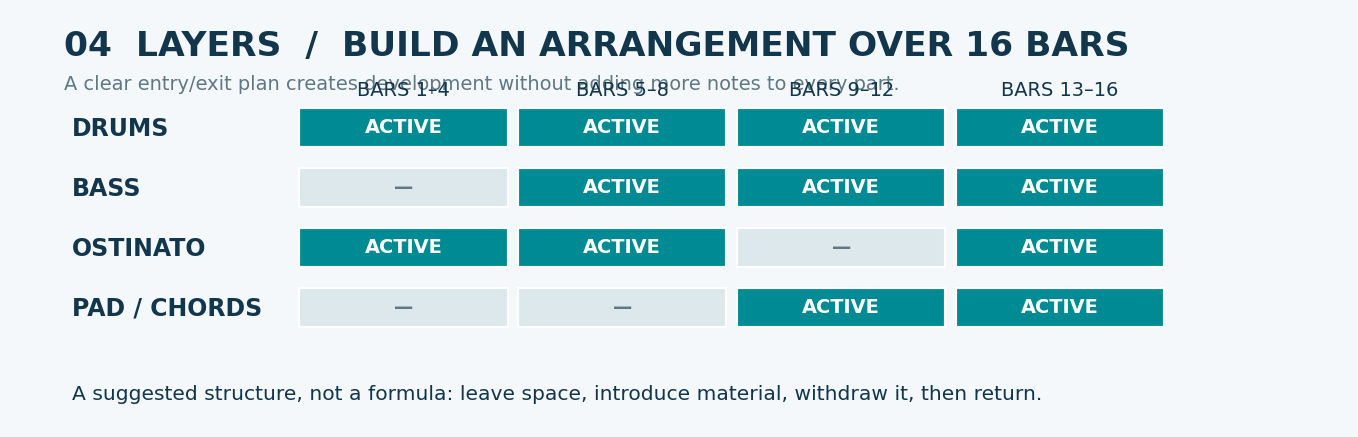
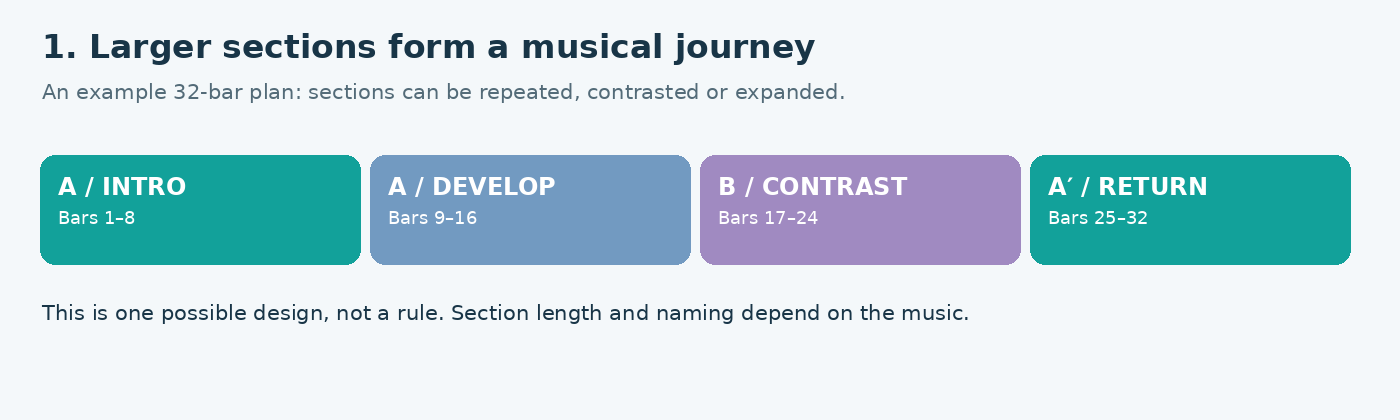
Structure gives a composition a sense of direction. An opening idea may be developed, contrasted and returned to, but many experimental pieces evolve through less conventional processes. Audibly changing density, register, harmonic rhythm or phrasing helps listeners recognise development.
Listening and revision
A first idea can be improved by removing as well as adding material. Check whether the central feature remains audible, whether bass and chords relate clearly, whether sections differ and whether the ending is deliberate. Changing a part in response to close listening is an essential composition decision.
Harmony and notation accuracy
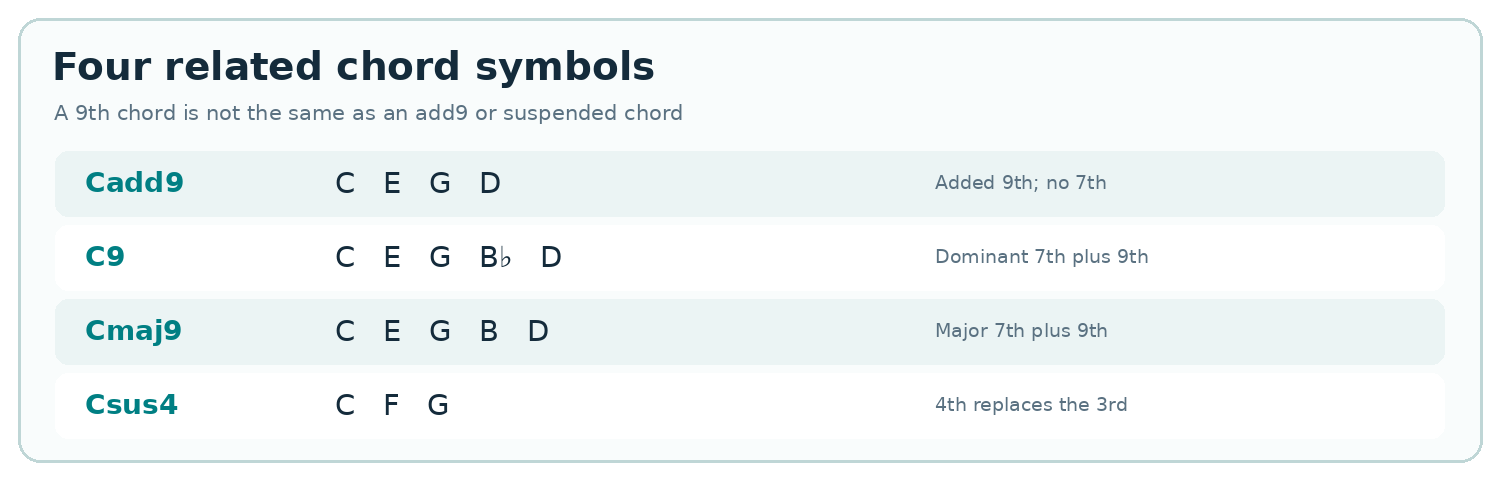
If a passage is described as C major, distinguish between using its scale pitches and establishing C as a tonic. Verify chord tones against the actual sounding harmony. Chromatic notes or intentional dissonance need not be corrected automatically: musical context matters more than a rigid ‘notes in key’ checklist.
Producing a complete result
An original piece needs a coherent beginning, development and conclusion, whatever its length. In a DAW, labelled regions and versions help preserve the progression from initial sketch to revised arrangement. A final audio bounce should include the intended ending and should be listened to outside the project to confirm the result.
Part of Volume 2 — How Music Works.