Extended chords build on seventh chords by adding further thirds, while added-note and suspended chords follow different principles. Chord symbols tell you which harmonic colours are intended, but not a compulsory keyboard shape.
The ninth, eleventh and thirteenth

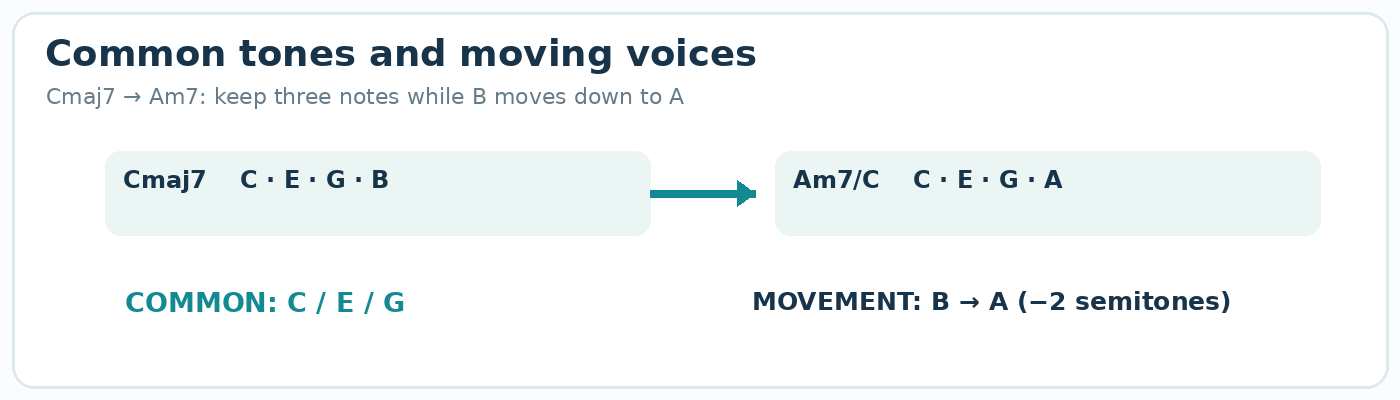
Starting with C–E–G–B (Cmaj7), continuing to stack thirds introduces D as the ninth, F as the eleventh and A as the thirteenth. These are compound intervals: a ninth is related to a second, an eleventh to a fourth and a thirteenth to a sixth. Performers may bring these notes closer together through octave displacement.
Major, minor and dominant ninths
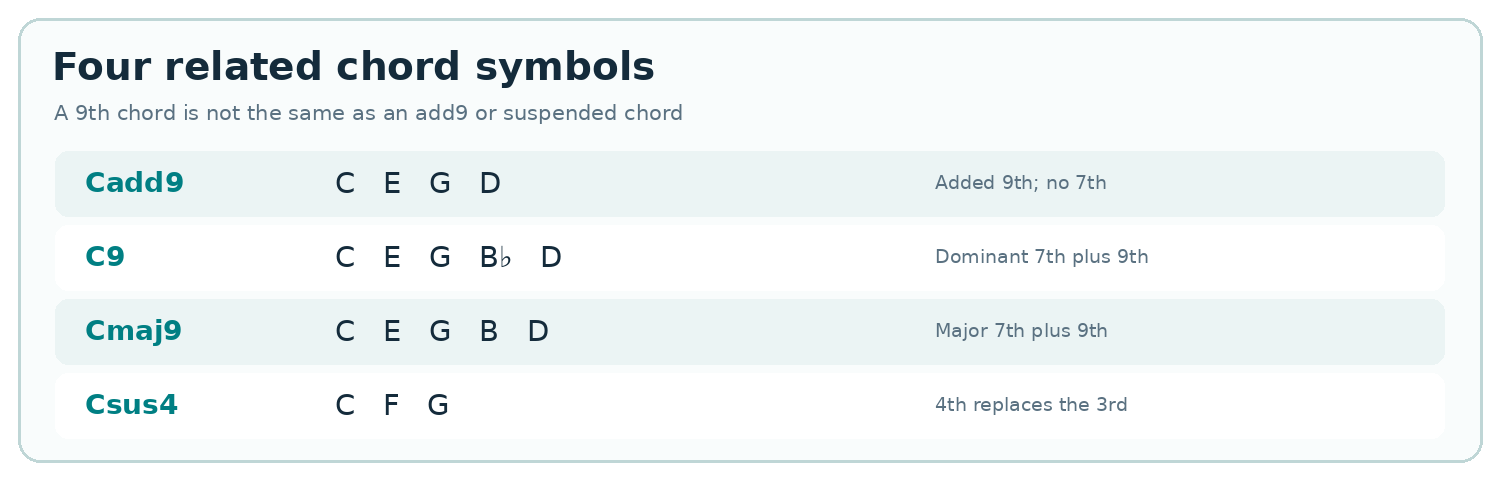
Cmaj9 is C–E–G–B–D, C9 is C–E–G–B-flat–D and Cm9 is C–E-flat–G–B-flat–D. A plain 9 chord conventionally implies a dominant seventh; maj9 includes a major seventh; m9 includes a minor triad and minor seventh.
Why add9 differs from 9

Cadd9 contains C–E–G–D without an implied seventh. C9 contains B-flat, and Cmaj9 contains B natural. These are not interchangeable chord symbols. C6 is C–E–G–A, while C6/9 adds D as well; neither automatically implies a dominant seventh.
Suspended chords
Csus2 is C–D–G and Csus4 is C–F–G. The third E is replaced by a second or fourth, so the ordinary major/minor third is absent. Csus4 to C involves F falling to E; a suspension can also remain unresolved in contemporary music. C7sus4 commonly adds B-flat to C–F–G.
Elevenths and thirteenths
A full theoretical C13 dominant stack is C–E–G–B-flat–D–F–A. Practical voicings often omit G, F and sometimes D while retaining the root, third, seventh and thirteenth. Natural F can clash closely with E, motivating alterations or omissions. A sharp eleventh above C is F-sharp, creating a different colour from F natural.
Practical voicings

Try low C with upper E–B–D for a sparse Cmaj9, or low C with E–A–D for C6/9. The fifth may be omitted without destroying the basic intended harmony. A low bass root makes otherwise ambiguous upper-note collections easier to hear.
Using these chords in a progression
Dm9 (D–F–A–C–E), G9 (G–B–D–F–A) and Cmaj9 (C–E–G–B–D) extend a ii–V–I in C major. Compare with Dm7–G7–Cmaj7 while keeping the chord roots and tempo constant. Note spacing, register and timbre all affect the outcome.
Explore the full How Music Works reference library.