The bass connects harmony with rhythm. Its pitch choices help establish a chord progression, while note length, timing and interaction with drums contribute to the groove. A useful bassline is not necessarily complicated.
Start with chord roots
For C | Am | F | G, the most direct bassline uses C | A | F | G. A low root under each chord clarifies the harmonic foundation. Holding each note for a bar makes the relationship easy to hear before adding rhythmic or melodic movement.
Root, fifth and octave

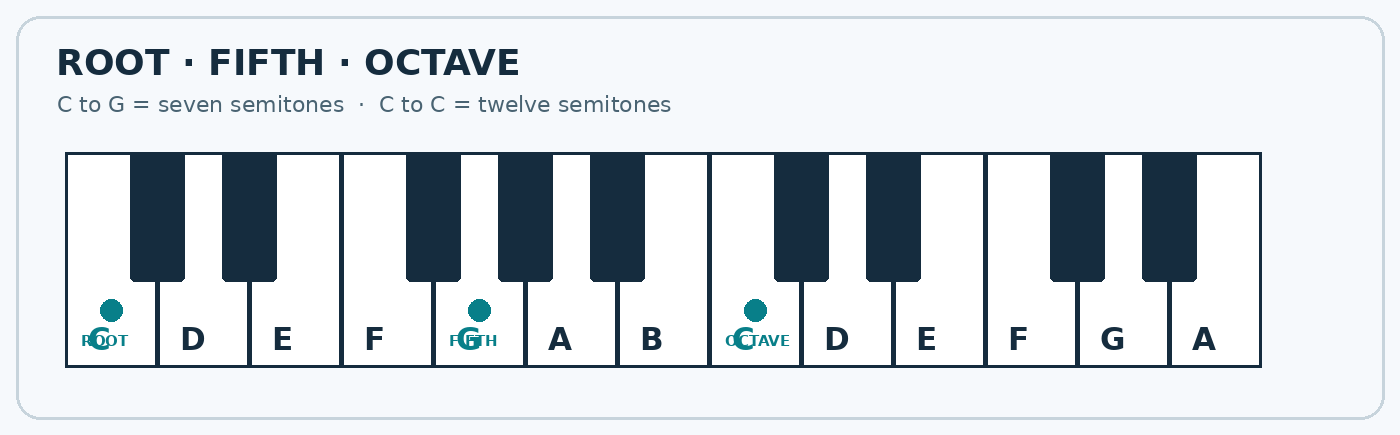
From C, G is a perfect fifth and the next C is an octave. From A, E is the fifth; from F, C; from G, D. Bass figures such as C–G–C or A–E–A move while retaining a clear harmonic link. Root-to-fifth is seven semitones; root-to-octave is twelve.
Timing changes the groove

Compare C on beat 1 and G on beat 3 with C on beat 1, G on the ‘&’ after beat 2 and C on beat 4. The pitches and tempo can stay the same, yet the placement changes the feel. Rests, shorter note durations and accents can be as effective as additional pitches.
Passing notes

A passing note connects more stable targets. When moving from C harmony to F, a bass phrase C–D–E–F can make F feel like a destination. The intermediate D and E are chosen for their movement; whether they clash or blend depends on which chord is sounding when they occur.
Chromatic approach notes
An approach note can be outside the key. F♯ immediately before G creates a semitone approach to G, even in a C-major passage. The chromatic note does not necessarily imply a new key. Its placement and duration shape the effect.
Bass and drums
Bass attacks aligned with a kick can reinforce the pulse. A bass attack between kick hits can create syncopation or space. Compare bass and drums separately, then together; the relationship may matter more than the complexity of either part alone.
Register and MIDI articulation
Extremely low pitches may not translate clearly on small speakers. A bass patch may also respond to note overlap, velocity and legato differently from another sound. In Logic Pro, note length and attack positions can be edited independently; shorten overlapping notes if a monophonic synth is behaving unexpectedly.
Building a comparison
Over unchanged C–Am–F–G harmony, compare three bass approaches: sustained roots C–A–F–G; roots and fifths C–G | A–E | F–C | G–D; and a rhythmic variation with rests or passing notes. Listening to these alternatives illustrates how a bassline shapes movement without changing the chords.
Part of the How Music Works reference library.