Voice leading is the movement of individual pitch lines through changing harmony. Instead of treating each chord as an isolated block, follow which notes remain, rise, fall or leap. Good voice leading may be economical, but musical intention can also justify wide movement.
Common tones in seventh chords

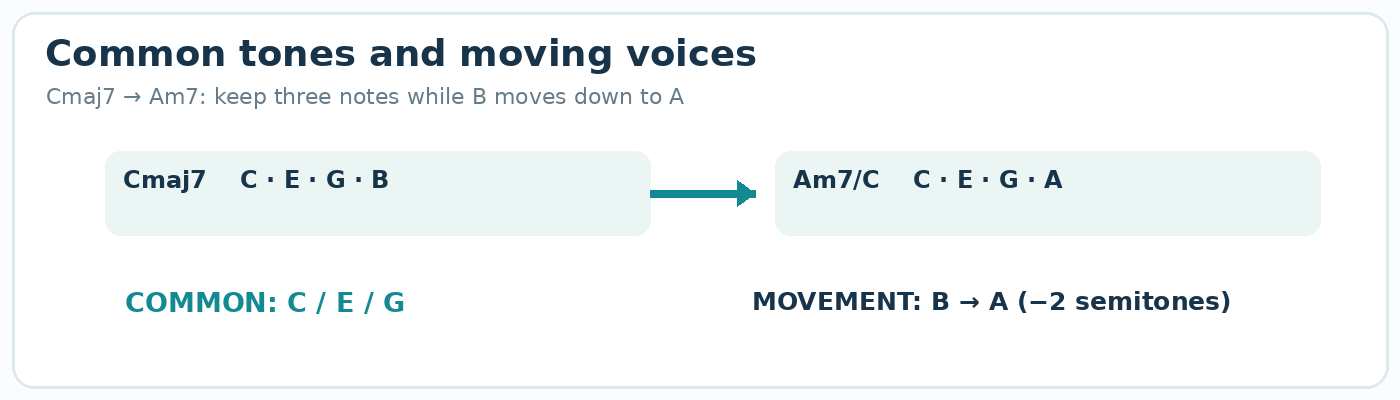
Cmaj7 (C–E–G–B) and Am7 (A–C–E–G) share C, E and G. Moving from C–E–G–B to C–E–G–A retains those three pitches and moves only B down to A. The destination is Am7/C if C is the lowest note. With an independent lower A bass, the complete texture is Am7 in root position.
Contrary, oblique, similar and parallel motion
Contrary motion means two voices move in opposite directions. Oblique motion means one voice holds while the other moves. Similar motion sends both in the same direction; parallel motion is similar motion that preserves their interval. These terms describe independent melodic strands within a texture.
Guide tones

In seventh chords, the third and seventh often communicate their quality and function. G7 has B as third and F as seventh; Cmaj7 has E as third and B as seventh. In a familiar tonal resolution, B can rise to C while F falls to E, forming a clear dominant-to-tonic gesture.
Compact and open voicings
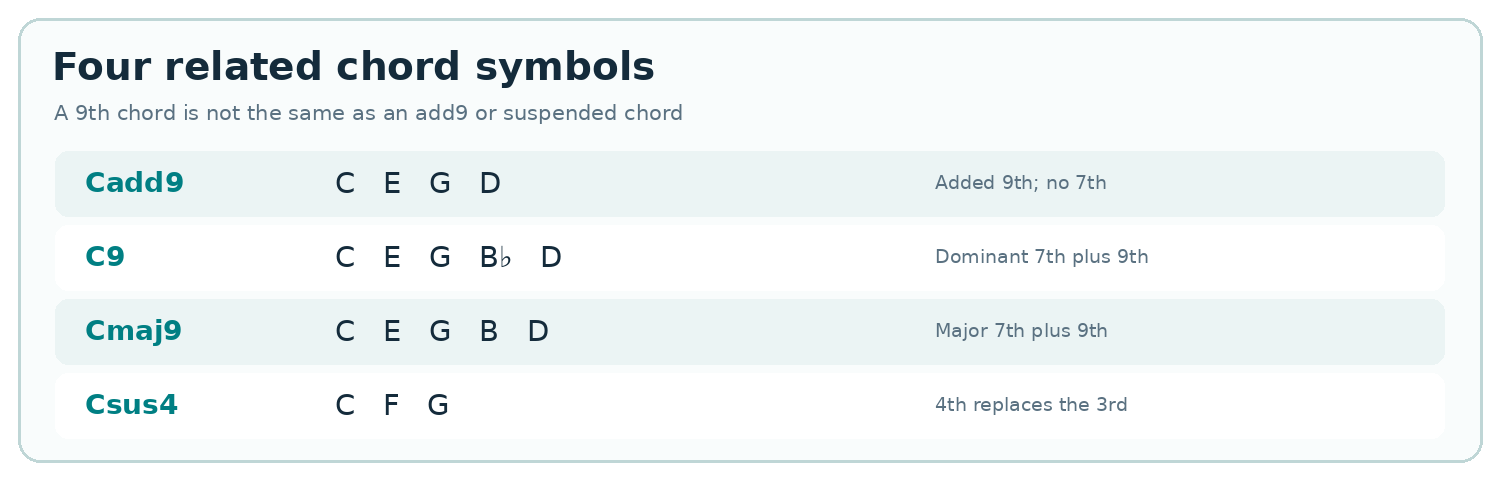
A close-position voicing groups notes relatively tightly, while an open voicing spreads them. Low C with E–B–D above can represent Cmaj9 without the fifth. Low G with B–F–E can suggest G13 while omitting its fifth, ninth and eleventh. Musical context, bass and register help clarify sparse shapes.
A four-chord example

One Cmaj7–Am7–Fmaj7–G7 sequence can be voiced C–E–G–B | C–E–G–A | C–E–F–A | B–D–F–G. The listed upper collections are respectively Cmaj7, Am7/C, Fmaj7/C and G7/B when their first notes are the lowest. Adding lower roots C–A–F–G changes the full sonorities into root-position seventh chords.
Independent upper and bass lines
A fixed melodic pitch can change harmonic role underneath moving chords. E can be sustained across Cmaj7, Am7 and Fmaj7 because it belongs to all three, though with different functions. A contrasting upper line E–G–A changes contour and interaction without necessarily changing the chord progression.
Voice leading in the Piano Roll
The Piano Roll lets producers track pitches horizontally between chords. Compare root-position chord regions with inversions retaining more common note rows. Then audition both with and without independent bass roots. Smoother motion is a tool, not a universal musical goal.
Explore the full How Music Works reference library.