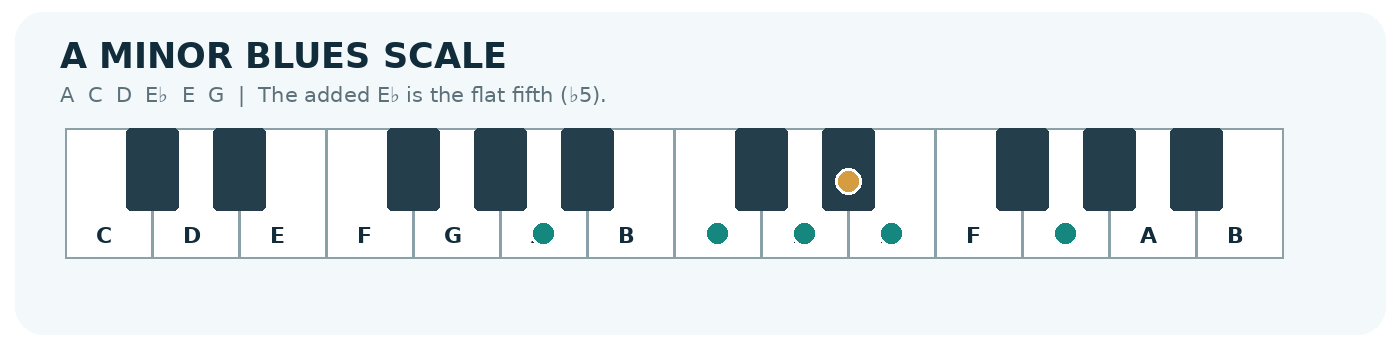
Pentatonic scales contain five pitch classes per octave. They are useful for riffs, improvisation and melodic composition because a limited note collection leaves space for rhythm, contour and expressive phrasing.
Major pentatonic

The common major pentatonic formula is 1–2–3–5–6. C major pentatonic is C–D–E–G–A: the fourth and seventh degrees of C major are left out. G major pentatonic is G–A–B–D–E. These scales are defined by their interval relationships rather than a fixed set of white keys.
Minor pentatonic

The minor pentatonic formula is 1–flat 3–4–5–flat 7. A minor pentatonic is A–C–D–E–G. It contains exactly the same pitch classes as C major pentatonic, making those forms relative. C minor pentatonic, C–E-flat–F–G–B-flat, is parallel to C major pentatonic, not relative.
The minor blues scale

A commonly taught six-note minor blues scale adds a flat fifth to minor pentatonic. In A, this gives A–C–D–E-flat–E–G. E-flat lies between D and E and can act as a chromatic approach note. Real blues expression also involves pitch bends, articulation and intonation that fixed equal-tempered notes do not fully capture.
Riffs, pauses and variation
A–C–D–E may form a one-bar figure, answered by E–D–C–A. Repeat the rhythm, alter one ending, add a rest or move the motif into a new register. Pentatonic melody depends on timing, accents and repetition as much as note choice.
Chord tones and colour notes
Over Am (A–C–E), A, C and E are chord tones while D and G add other scale degrees. Over F major (F–A–C), A and C are chord tones and E can create a major-seventh colour. A pitch is not automatically consonant just because it belongs to a pentatonic collection.
Blues inflection against harmony
Blues-based melodic language sometimes places a minor-inflected third against a major or dominant accompaniment. The resulting clash can be deliberate. Listen for how the melodic pitch bends or moves into the harmony rather than classifying every non-chord note as a mistake.
A MIDI comparison
Keep an Am drone and drum groove fixed, then compare an A-minor pentatonic riff with one using E-flat briefly before E. The changed pitch isolates a blues-scale colour, while the phrase’s rhythm and supporting harmony remain familiar.
Explore the full How Music Works reference library.