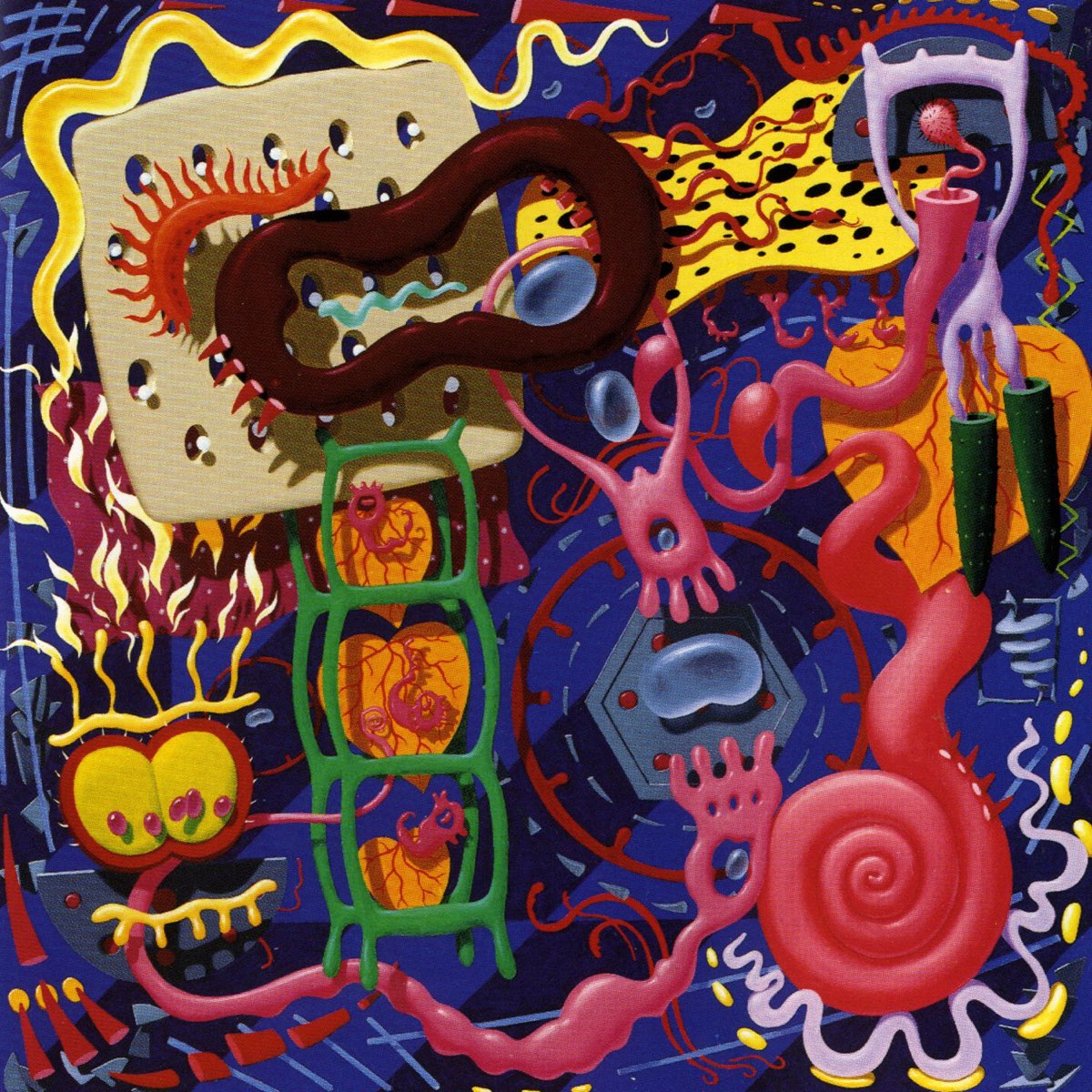
Released in 1996, In Sides is one of Orbital’s most expansive records. Its long tracks move between melodic techno, sampled percussion, restless rhythmic fragments and music that approaches film scoring. For Paul and Phil Hartnoll, it was also an opportunity to use electronic instruments in more personal, narrative ways.
Recorded at Strongroom: the instruments
In a detailed 2022 interview with Future Music, Paul Hartnoll described recording the album in a small room at London’s Strongroom Studios in Shoreditch. His list of principal instruments is unusually specific: an E-mu Emulator III sampler, Roland TR-909 and TR-808 drum machines, Roland R-8 and R-70 rhythm machines, SH-101 and SH-09 synthesisers, Oberheim Xpander, Jupiter-6, ARP 2600 and Roland System 100. The duo also sampled acoustic drumming by Craig McClune.
That combination helps explain the record’s breadth. Programmable drum machines supplied stable rhythmic patterns; the sampler allowed sounds to be reordered and transformed; and instruments such as the ARP 2600 and Xpander supported complex, evolving tones. However, a list of equipment should not be mistaken for a complete account of every sound. Specific attributions below are used only where Paul described a particular recording method.
The Girl with the Sun in Her Head: solar power and remembrance
The opening piece began as music considered for the 1995 film Hackers, but was not used in the finished film. Orbital kept developing it into a much longer album composition. The recording session has an unusually concrete environmental detail: Greenpeace brought its mobile solar-power generator, called Cyrus, to Strongroom, and the track was recorded using the electricity it supplied.
Paul has also explained the track’s personal significance. It commemorates their friend Sally Harding, a photographer associated with electronic music and rave culture, who died while the music was being made. The slow expansion of the arrangement gives the piece a reflective quality; it moves from restrained pulses and sustained tones into a fuller, more rhythmically animated sequence.
The solar-powered session and dedication are documented in Paul’s own track-by-track account. They are more illuminating than simply labelling the piece ambient techno, because they show how its creation, title and emotional context intersect.
P.E.T.R.O.L.: sampling percussion for a racing game
P.E.T.R.O.L. is connected to the early Wipeout videogame. Paul described approaching it almost as an imagined racing score, making a collection of short aggressive sounds by triggering an ARP 2600 and recording the results to DAT. He combined those sounds with material sampled from Craig McClune’s drumming, constructing a dense rhythmic bed influenced by jungle and drum and bass.
One of the more precise production details concerns the Oberheim Xpander: Paul held notes to create a sustained, cycling sound and made use of the instrument’s ability to place individual voices across the stereo field. This helps account for the track’s sense of motion and pressure without pretending that the whole arrangement came from one synthesiser.
The Box: polyrhythm, film music and Tilda Swinton
The Box is split into two parts on the official album track list. Paul has traced the first part back to experiments with patterns cycling at different speeds, drawing inspiration from Steve Reich. Its bell-like figures and melodic gestures also reflect his interest in film and television composers, including Ennio Morricone.
The second movement was developed by speeding up and redirecting the material, giving the music a more urgent, cinematic character with touches of jungle rhythm. The accompanying video featured Tilda Swinton, introducing another striking element to the record’s presentation. It is a useful case study in how changing tempo, rhythmic emphasis and instrumental density can transform the identity of a composition.
Watch/listen: The Box, official video.
Dŵr Budr: an environmental event and a late addition
The Welsh title Dŵr Budr means dirty water. According to Paul, it was inspired by the oil spill on the Pembrokeshire coast. He also said that he wrote the track in a single day, immediately before the album was mastered, because he felt the record needed another piece. It includes a guest vocal by Alison Goldfrapp, credited under the name Auntie.
The track’s creation is striking in the context of the album’s elaborate arrangements: technical complexity did not always mean long periods of revision. Sometimes a track emerged quickly from an idea that was already clear.
Adnan’s: recording the world outside the studio
Adnan’s had earlier appeared in a shorter form on the War Child charity compilation Help. Paul said the original had been written and recorded in a day. Its subject was connected to a news report about the conflict in Bosnia, while some of the percussion came from recordings of building materials and resonant pipes at a friend’s workspace.
Those recordings were not just incidental atmospheric effects. Recording a sound, sampling it and repeating or pitching it turns ordinary physical objects into musical instruments. It is an extension of Orbital’s earlier interest in environmental sound, now placed within a more sombre context.
Out There Somewhere?: composing as the track unfolds
The album’s two-part closing composition runs for roughly 23 minutes. Paul described writing it linearly, discovering successive sections as the track developed rather than working from a complete formal plan. Early electro-style material gives way to gentler, film-score-influenced harmony and then builds into an increasingly animated conclusion.
One of the most revealing details concerns the E-mu Emulator III. Paul used velocity to change the start position within a sample, shifting which part of the recorded material played. In his account, this allowed the same underlying figure to move from minor to major, producing a significant harmonic change without replacing the entire sequence. It illustrates how the sampler was used not only for triggering sounds but as an instrument for controlling musical structure.
A production lesson in contrast and development
In Sides is full of contrasts: a delicately evolving sequence can lead into busy programmed percussion; sampled acoustic material sits alongside analogue synthesiser lines; and one composition can change emotional character through the gradual introduction of harmony. The instruments matter, but their role within these long arrangements matters more.
For producers, The Box demonstrates rhythmic patterns moving at different rates, P.E.T.R.O.L. illustrates building a new percussion vocabulary from sampling and synthesis, and Out There Somewhere? shows a sampler changing the direction of a long-form harmonic idea. These techniques are useful in contemporary software as well as vintage hardware.
Where In Sides fits in Orbital’s catalogue
Coming after 1994’s Snivilisation, In Sides retained Orbital’s interest in politics and environmental themes but expanded the scale of individual compositions. Read the full Orbital album chronology, our guide for first-time listeners and the existing Iconic Albums feature for the surrounding releases.
Sources and editions
The recording details and track histories here are drawn primarily from Paul Hartnoll’s track-by-track interview. The official Orbital discography confirms the original album track sequence. For further listening, consult those editions rather than assuming every streaming reissue has the same track order.
Find In Sides on CD
Affiliate disclosure: As an Amazon Associate, we earn from qualifying purchases. Edition and availability may change. Orbital – In Sides (UK CD).