A mode is more than a scale fingering. Its identity depends on the interval pattern around a convincing tonal centre. The same seven pitches can create different modal experiences when the bass, melody and harmony establish different notes as home.
Relative and parallel modes

C Ionian and D Dorian contain the same seven white-key pitch classes but emphasise C and D respectively as tonic: they are relative modes. D Dorian and D Aeolian both centre on D but use different notes: they are parallel modes. Playing D to D on the white keys does not automatically prove a passage is Dorian.
The seven diatonic modes
Ionian: 1–2–3–4–5–6–7. Dorian: 1–2–flat 3–4–5–6–flat 7. Phrygian: 1–flat 2–flat 3–4–5–flat 6–flat 7. Lydian: 1–2–3–sharp 4–5–6–7. Mixolydian: 1–2–3–4–5–6–flat 7. Aeolian: 1–2–flat 3–4–5–flat 6–flat 7. Locrian: 1–flat 2–flat 3–4–flat 5–flat 6–flat 7.
The characteristic scale degrees

D Dorian (D–E–F–G–A–B–C) has a natural sixth B, unlike D Aeolian (D–E–F–G–A–B-flat–C). G Mixolydian has F natural rather than F-sharp of G Ionian. C Lydian has F-sharp rather than F natural. D Phrygian introduces E-flat as the flat second.
Drones and tonal centre
A sustained D beneath a melody can strengthen D as tonal centre. Compare D Dorian and D Aeolian using the same D drone while changing B natural to B-flat. The important interval difference becomes easier to hear when the tonic remains constant.
Modal vamps

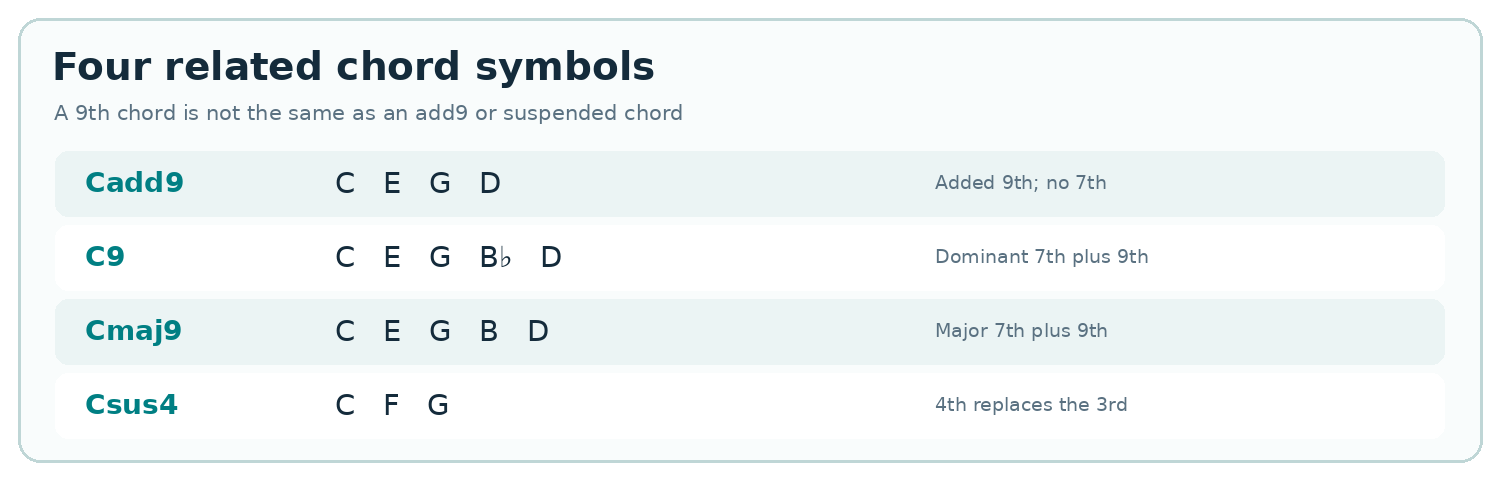
Alternating Dm7 (D–F–A–C) and G (G–B–D) is a useful D Dorian vamp because B natural appears in the G chord. Dm7 with B-flat major (B-flat–D–F) suggests D Aeolian colour instead. In both cases, recurring bass D or phrase arrivals on D help make the tonic audible.
Modal colour without conventional cadences
A conventional V–I may strongly suggest major/minor tonal function. Drones, vamps and characteristic melodic tones can maintain a modal centre without that cadence. Modal music may still change chords; form, melody and bass determine how the mode is perceived.
Modes in production
Use a sustained tonic, programme a riff with the mode’s characteristic degree, and compare it with a parallel mode while retaining tempo and timbre. The exercise isolates the pitch relationships instead of equating modes with predetermined moods.
Explore the full How Music Works reference library.