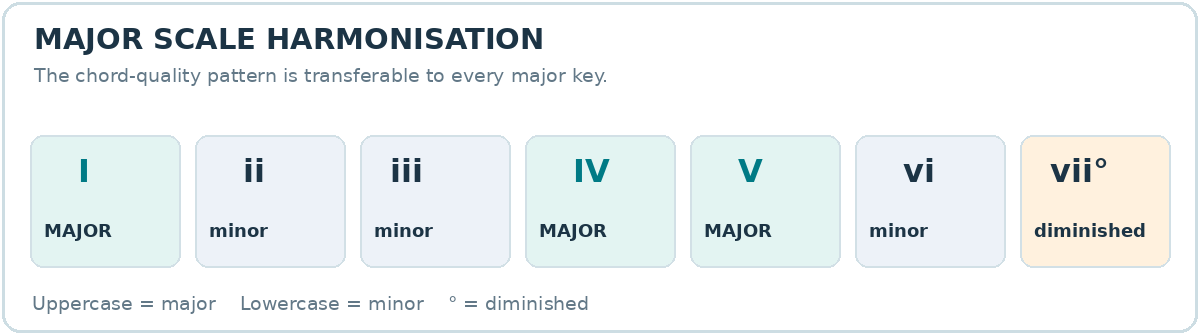
A major scale provides seven notes from which we can build a family of related chords. These are diatonic triads: they use only notes from their source scale. Understanding them makes it easier to analyse chord progressions, transpose songs and construct harmony deliberately.
Building triads from a major scale

C major contains C–D–E–F–G–A–B. Take a starting note, skip one scale degree, take the next, skip another and take the fifth. Starting on C gives C–E–G; starting on D gives D–F–A. Continue from each scale degree and you obtain seven triads.
The seven diatonic chords in C major

I: C major (C–E–G); ii: D minor (D–F–A); iii: E minor (E–G–B); IV: F major (F–A–C); V: G major (G–B–D); vi: A minor (A–C–E); vii°: B diminished (B–D–F). The resulting qualities form the pattern major, minor, minor, major, major, minor, diminished.
Why the qualities change
The scale’s spacing of tones and semitones determines the intervals in its chords. D–F is a minor third and D–A a perfect fifth, making D minor. B–D is a minor third and B–F a diminished fifth, making B diminished. We do not assign qualities arbitrarily; they follow from the note collection.
Roman numerals

Roman numerals describe the chord root’s position relative to a tonic. Uppercase numerals identify major triads, lowercase minor ones, and the degree sign ° indicates diminished. IV is F major in C major but C major in G major. The numeral names a scale degree, not the number of pitches in the chord.
Tonic, dominant and chord order
A C–F–G–C progression (I–IV–V–I) can establish a C-major point of arrival. C–Am–F–G is I–vi–IV–V, while Am–F–C–G is vi–IV–I–V. Changing chord order alters the bass path and points of emphasis, even if the same chords recur. Harmonic rhythm describes how frequently those chords change.
Moving the progression into G major
G major contains G–A–B–C–D–E–F♯. Its diatonic triads are G, Am, Bm, C, D, Em and F♯dim. Thus I–vi–IV–V becomes G–Em–C–D. The absolute pitches change, but the scale-degree pattern stays consistent. Roman numerals make the transposition straightforward.
Using this in electronic production
Try a four-bar MIDI progression of C–Am–F–G using sustained triads, then alter the rhythm or order. Diatonic choices give a coherent starting collection, but a strong tonic also depends on melody, bass, phrase endings and repetition. Borrowed harmony and chromatic notes can expand these options without negating the diatonic framework.
Explore related articles in How Music Works — Volume 2.